Book

After Reading Kim Ji-young, Born 1982

19.10

January 10, 2024 

“She was never trying to be extraordinary — she just wanted to live without being questioned.”

Sometimes I wonder why, after all these years, being a woman still feels like walking on a road that keeps asking for permission.

Reading Kim Ji-young, Born 1982 felt like looking into a mirror I never asked to stand in front of.
Ji-young is ordinary — painfully so — yet in her quiet unraveling, I found pieces of every woman I have ever known.
The exhaustion.
The politeness.
The constant need to endure.

The book doesn’t shout — it whispers.
It doesn’t dramatize her suffering, it simply list what she has endured.
And that simplicity hits harder than any tragedy.
It’s not the one big heartbreak, but thousands of small ones — 
written like medical notes, symptoms of deeper disease we’ve normalized for generations: 
that women must be kind but not too assertive, capable but not too ambitious, strong but never tired.

This book didn’t comfort me — it reminded me.
That anger can be quiet.
That pain can be polite.
And that survival itself can be a form of rebellion.

Maybe that’s what Ji-young —and many women out there — wanted all along — 
not sympathy, not praise — just the freedom to exist without explanation.

And maybe that’s what I want too.
To forgive myself for not being perfect, for being angry, for being exhausted— 
for never feeling the urgency to explain why.


Book

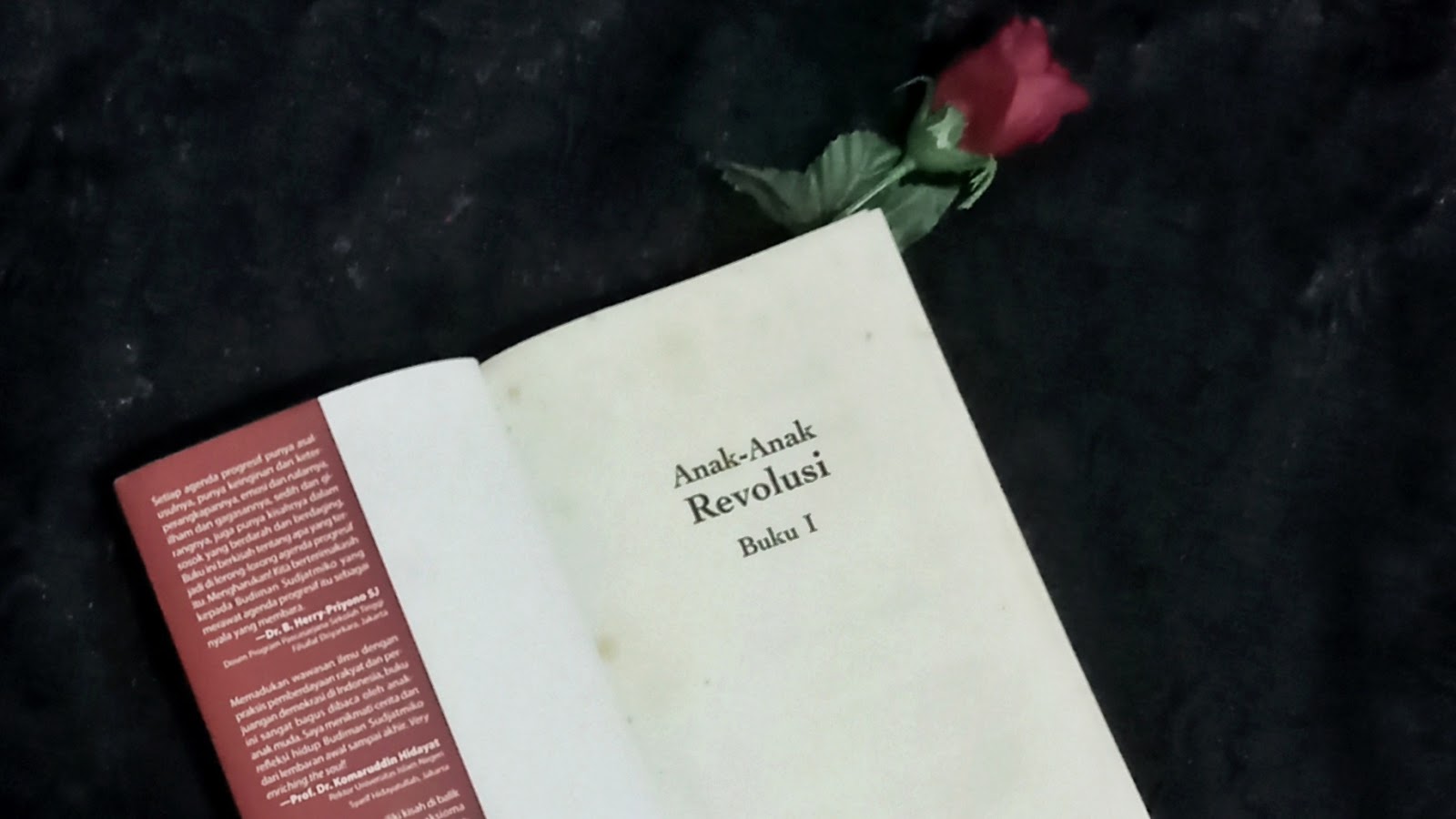
Anak-Anak Revolusi (First Book): Opposing Against Corrupt Regime

22.29

September 15, 2018

Reading this Novel-like Autobiography was a challenge at first. Despite my curiosity about politics, I am also in a position between skeptic and apathetic. This four hundreds thick of papers is written by a politician from a government side, Budiman Sudjatmiko (Partai Demokrat Indonesia Perjuangan).

During this second time of reading, i read and tried to discern every words into pieces of depiction and arrange it in the end to see what's the big picture I portray after a week of battle between slumber and cats in my head. This agenda of re-read the book is also a part of my way to learn about Indonesia, in terms of politics. 

I was as bewitched as the first time when I got this book as my 17th birthday gift from my sister and read this. Through very eloquent words, Budiman Sudjatmiko presented an explicit picture of how thrilling it was, since the beginning, fighting off people with power, dominance, arms, and faint consciences. There's this section entitled "Cakar-Cakar Kekuasaan" which straight-forwardly herd me into a gripping moments when Budiman Sudjatmiko and his fellow partisan were pursued and tortured by the regime's henchmen (Soeharto Era).

The story rises from Budiman Sudjatmiko's childhood. Where he lived in Majenang, surrounded by the inevitable bitter reality of people lived in poverty. Where he started contriving his idealistic toward democracy and prosperity. From a quiet night which let him to witness a suicide of Mbah Dimin, an old man who decided to lose and surrendered from life, from vicious destitution which introduced him to loan sharks.


There's this paragraph that I see it as a reality, still:

"The reality, they couldn't help Mbah Dimin when he was alive, when he was in debt. They only showed their compassion after he was found dead. They gave him tribute and honor in his funeral, reading him forced obituaries and burning incense. I believe that they respect a body because they refused to help the living humbly."

How am I supposed to say it? Sometimes we reason and make excuses, that we are in no better condition to help. And I do this, at times.

Budiman Sudjatmiko embellished his story with little-or-much quotations and phrases from related books to support and justify his notions. From these, I envy him so much for spending most of his time being curious and searching the world. He is a passionate reader and spirited politician since young. Reading Anak-anak Revolusi was like jumping between books and journals, also as if I were a bench where he tried to explain every words said by an elaborated sources of facts, views of others, and fixed theories. Budiman Sudjatmiko provides his reasoning of how he perceived things.

More than glorifying his abundant of excruciating experiences or dramatizing every affliction, he wrote the flow in a good manner, where I could imagine how the kid Budiman Sudjatmiko grew onto an awkward adolescent, fledged onto a half-mature man until he finally immersed completely into practical politics during his college study.  

In the last few pages, Budiman Sudjatmiko depictured his life as a political prisoner, the life of some "democracy fighters" from a secluded penitentiary striving their vision, steering the movement and battle from inside.

Besides, life was never been so much fun without love story.

Budiman Sudjatmiko met by his very first lover and loved one in an unfathomable moment. That was a tickle between cries, a rose in a wild-wood. Beautiful.